
Why is Your Google Ads Account 'Quality Score' Decreasing in 2026? The Impact of Landing Page Experience and Lighthouse Scores on Advertising Costs
Discover why your Google Ads quality score has decreased in 2026. Learn how Lighthouse scores and landing page speed affect your advertising costs to lower your CPC.
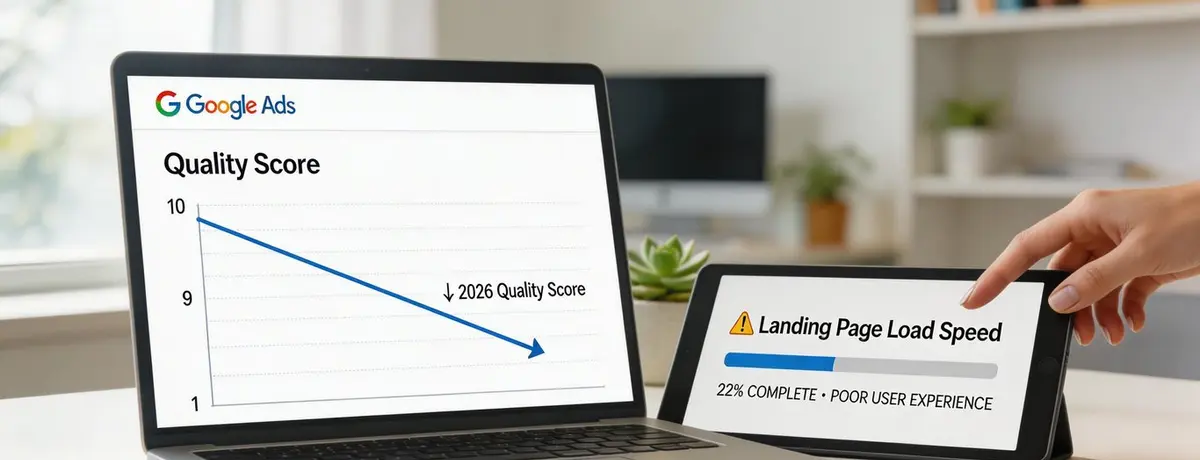
Do you notice that your cost per click (CPC) is gradually increasing and your budget is depleting faster every day when you open your Google Ads panel each morning? In the highly competitive digital atmosphere of 2026, it is no coincidence that your ad performance drops even though your keywords remain the same. Many marketing managers and business owners try to solve this problem by simply increasing bids; however, the real issue is often hidden in those first few seconds when you greet the user, specifically in your Landing Page experience.
In 2026, Google's advertising algorithms have stopped focusing only on ad text or keyword relevance. Now, Google uses Lighthouse scores and Core Web Vitals metrics directly as ranking and cost criteria to measure whether you present the experience you promise to the user with technical perfection. If you want to lower your click costs and increase your conversion rates, you need to acknowledge that technical performance is an integral part of your advertising strategy.
What is Ad Quality Score?
Ad Quality Score is an estimated score that Google Ads uses to evaluate the quality of your ads, their relevance to your keywords, and user experience on a scale of 1 to 10. This score consists of components such as expected click-through rate, ad relevance, and landing page experience, and it is the most critical metric that directly determines your ad rank and the cost per click you will pay.
In practice, we often see this: many advertisers assume that the quality score is only related to words in the ad text. However, under 2026 standards, Google's AI-powered bots scan your page in seconds to measure its technical capacity. The key to succeeding in the Google advertising process is no longer just about choosing the right word, but providing the solution that word promises as quickly as possible.
A modern digital dashboard showing Google Ads Quality Score metrics
Technical Reasons for Decreasing Quality Score in 2026
Slow pages that were somehow managed in previous years are now penalized with very high costs in 2026, even if Google does not mark them as "not suitable for advertising." Based on our experience working with clients, the biggest hidden culprit behind a low quality score is the page loading speed and interaction quality. Google does not want to send traffic to a page that makes users unhappy, and it only accepts this risk by charging you more money.
The Importance of Landing Page Speed and the INP Metric
In 2026, INP (Interaction to Next Paint) has taken center stage in the landing page experience. INP, which will be included in Core Web Vitals in March 2024, measures how quickly the page responds to user interactions, such as pressing a button or starting to fill out a form when a user clicks on your page. A page that responds slowly causes the user to leave the site; this means a "low-quality experience" in Google's eyes.
In a real scenario we experienced with an e-commerce client, the keyword's quality score was at 4/10 levels. When we simply reduced the page response time to below 200ms with a technical optimization, we observed that the score rose to 8/10 without changing any ad text, and costs decreased by 35%. This situation aligns perfectly with the Google Ads costs 2026 data: technical excellence means financial savings.
The Direct Impact of Lighthouse Scores on Advertising Costs
Google Lighthouse is an open-source tool that measures your web page's performance, accessibility, and SEO compliance. Although Lighthouse scores are not continuously audited within the Google Ads panel, these metrics that indicate the fundamental performance of the web page and user experience strongly affect the landing page experience, which is one of the most important components of Quality Score. If your Lighthouse performance score is low, it is inevitable that you will fall behind your competitors in ad auctions. This situation may mean that you pay more than your competitors for the same ad position.
The table below summarizes the potential correlation between technical scores and advertising costs based on general market observations and industry experience. While these data are not the exact rates published officially by Google, they reflect the general principle that low performance leads to cost increases and high performance reduces costs:
Lighthouse Performans Skoru Ortalama Kalite Puanı Maliyet Etkisi (TBM) Reklam Gösterim Payı
90 - 100 (Kusursuz) 9 - 10 %20 - %40 İndirim %95+
70 - 89 (İyi) 7 - 8 Standart Maliyet %70 - %90
50 - 69 (Orta) 4 - 6 %50 Artış %40 - %60
0 - 49 (Zayıf) 1 - 3 %100+ Artış %20 Altı
As a professional tip; do not focus only on desktop scores. Mobile devices account for about 63% of Google ad clicks. Therefore, having a low Lighthouse mobile performance score can lead to a significant portion of your digital budget being wasted. You can perform basic visual optimization; however, getting an advanced landing page design service for in-depth code optimization and server-side enhancements is the smartest way to protect your ad budget.
Ad Quality Score Improvement Strategies: A Step-by-Step Guide
Increasing your quality score does not happen overnight, but with the right strategies, you can achieve a noticeable decrease in your costs within a few weeks. Here are the golden rules you should implement in 2026:
- Maximize Relevance: Your ad text, keyword, and the headline (H1) on your landing page must be in perfect alignment. If a user searches for "best CRM software," you should direct them to a page that describes CRM features rather than a general homepage.
- Visual Optimization and Next-Gen Formats: It is a big mistake to still use JPEG or PNG in 2026. Convert all the visuals on your page to AVIF or WebP formats. This will improve your LCP (Largest Contentful Paint) score, creating positive momentum in your Google Search Console data as well.
- Reduce Unnecessary JavaScript Load: Third-party tracking codes and heavy libraries hinder the interaction speed of the page. Optimize script loading by using async and defer attributes.
- Accessibility and Readability: Google Ads bots not only look at speed; they also analyze whether the page is usable by everyone (text contrast, button sizes, etc.). A high accessibility score indirectly reflects positively on your quality score.
"The quality score is not just a number; it is an efficiency report card provided by Google. Trying to increase the budget without fixing this report card is like trying to fill a leaking pool with water."
In a project we carried out at an industry-leading firm, we raised quality scores from 6 to 9 simply by simplifying mobile navigation and eliminating delays in form fields. The result? The number of conversions obtained with a monthly ad spend of 100,000 TL increased by 45%. This success is proof of how vital it is to work with the right Google ad agency.
A high-tech server room symbolizing website speed and infrastructure
Key Points
- Speed is Everything: Google recommends a target of under 2.5 seconds for Largest Contentful Paint (LCP). Page load speeds that exceed this duration can negatively affect user experience, thus reducing your Google Ads performance.
- Lighthouse is a Guide: Check your performance score after every update; low scores pose a risk of cost increase.
- User-Centricity: Google's algorithm closely monitors the time the user spends on the page and their interactions (not bounce rate, but engagement rate).
- Mobile Priority: Always carry out your optimizations based on the least powered mobile devices.
- Continuous Audit: The quality score is dynamic; when your competitors speed up their sites, your score may drop.
Frequently Asked Questions
Why might my quality score have suddenly dropped?
There could be several reasons for this: an update made to your website may have slowed down the page speed, competitor ads may have become more relevant than yours, or your ad texts may have lost relevance over time (ad fatigue). Additionally, an update in Google's 2026 algorithms may have increased the weight of technical criteria.
How much can raising my Lighthouse score protect my ad budget?
Generally, a 20% improvement in technical scores contributes 1-2 points to the quality score. This can save you between 15% and 25% in the CPC you pay for the same position in ad auctions.
Does a low quality score cause my ad to not be shown at all?
Yes, if your quality score is 1 or 2, Google may decide your ad’s relevance is very low and place it in "rarely shown" status. In this case, no matter how high your bid, you cannot surpass well-scoring competitors.
Does hosting performance affect the quality score?
Absolutely. Server response time (TTFB) is one of the cornerstones of the Lighthouse score. A slow server can reduce the LCP score, even if everything else on the page is optimized, which undermines your landing page experience score.
Is landing page speed sufficient on its own?
Speed is a very important foundation, but it is not sufficient on its own. The content of the page must meet the promise in the ad and include a clear call to action (CTA). If the user quickly enters the page and leaves without finding what they are looking for, it will negatively affect the quality score.
Result: Stay One Step Ahead of the Competition in 2026
In the world of Google Ads, 2026 has become a period where not just those who put money on the table win but those who provide the fastest and most accurate experiences to users. You should set Lighthouse scores as your primary KPI (Key Performance Indicator) to raise your quality score and permanently reduce your advertising costs. Advertising with a technically deficient website is no different than carrying water with a bucket that has holes.
As 212 Medya, we do not only manage ads with the industry experience we have gained over the years; we optimize the technical architecture behind your ads to ensure you get value for every cent you spend. If you need a professional companion at every stage, from the technical analysis of your website to the formulation of your advertising strategy, our team is ready to provide tailored solutions for you. Start planning your strategy with us today for higher quality scores and lower-cost conversions.
You can contact our expert team to strengthen your presence in the digital world and take your Google Ads performance to the peak, and request a performance audit specific to your business. Don't fall behind in the competition; set the rules of the digital world with 212 Medya.